Saturday, September 15, 2012
Creating Affirming Environments
Creating Affirming Environments
Creating an authentic early childhood setting is something that I think is important for the comfort level of the child and their family.
If I were to have an early childhood home setting, I would have a sign-in or information area. This area would have a binder for sign-in and a calendar/bulletin board for information for the family. I would also have an area for children to adjust to the environment. For example, if the child were still tired and not ready to play, I would have an area for them to relax. This would also help the child feel more comfortable.
It is important that I would be able to see the child, but also attend to the other children who are ready for the day. In my home, the front room would be used for a “quiet” corner and the connecting room would be filled with children.
I would also have an area for center time. This area would be big enough for us to gather and learn about our daily skills and discuss our day. This area would have photos and signs on the walls. The photos would be diverse and show varying cultures, photos of the children attending the center, photos of my family, and photos of varying abilities. I believe that this is important to help create a family feel for the environment.
I would also have an area that each family could pick items for display that they enjoy doing or they would use to help describe themselves. We would change this every two weeks. This would allow the children and families to have several times throughout the year that they could use items to help other families and staff get to know them better.
I think that in the pretend/dramatic play area, I would have a variety of costumes and careers that the children could explore. The dolls would also include a variety of ethnicities and not just “token” examples (dolls that just change the color and not features). I have several dolls from my travels around the world that would be very beneficial in displaying real examples of clothing and features. I would reach out to other countries early childhood professionals to obtain games, dolls, and other examples from their country that they would use to represent their area.
Another aspect that I would love to incorporate would be a section with community activities. It is beneficial to include "children and adults from the various racial and ethnic identity groups in your community" (Derman-Sparks & Edwards, 2010, p. 43). I would ask families to post events that they like to attend in the community as well. It forms good rapport with families when you see them outside of the educational setting.
I noticed several wonderful examples from the video this week. I liked the sign-in area for transfer of information. I also liked the family of the month area. This would help build and strengthen positive rapport. I also liked the "quiet" transition area that she mentioned. This would be helpful for families to know that if their child is still tired that they could have time to wake-up since some families have to drop their kids off early. I enjoyed the video!
References
Derman-Sparks, L. & Edwards, J.O. (2010). Anti-Bias Education for Young Children and Ourselves. National Association for the Education of Young Children.
Laureate Education, (n.d.). Retrieved from www.waldenu.edu

Friday, September 7, 2012
Week 1 (6358)
Hello!
We are starting a new class and I am eager to learn new strategies regarding anti-bias education.
People can be different a limitless ways. My oldest son this week had to create an anti-bullying poster for their sharing project at school. Noah is in Kindergarten and did not even know what a bully was. I began our conversation with talking about how a bully makes fun of others, what it means to be a good friend, and what to do if he experiences bullying or witnesses it. Noah and I discussed why someone would make fun of others. I told him it was because bullies were making fun of others being different. Noah attends a Catholic school and he decided his poster should say, "Bullies make fun of people because they are different. God made us all different. Be kind." Those were the words of a six year old. Very honest and true. The next day, he asked me if people would make fun of our other son (Owen, age 3)for having a large scar on his head from his recent brain surgery. I told him that some people might. This comment upset him. He asked me why people had to be mean. This is one reason why I hope to become a proactive part of anti-bias education.
 (Photo of Noah and Owen in the hospital.)

Tuesday, August 14, 2012
BLOG: Week 8 (EDUC 6357)
 (PHOTO: All children learn differently and are beautiful!)
My professional goal is to become a developmental therapist. I will work with children from birth to age three who exhibit developmental delays. These delays can manifest in a variety of ways. The cultural background of the families will also be very different. I hope that as a developmental therapist, I will be respectful and accepting of diversity. It is important to treat each child as an individual and understand that they may learn differently. I am a strong believer that all children can learn at their own pace if given the proper tools and strategies.
(PHOTO: My son, Noah, on his first day of school. Kindergarten! The love of school starts so early!!!)
(PHOTO: All children learn differently and are beautiful!)
My professional goal is to become a developmental therapist. I will work with children from birth to age three who exhibit developmental delays. These delays can manifest in a variety of ways. The cultural background of the families will also be very different. I hope that as a developmental therapist, I will be respectful and accepting of diversity. It is important to treat each child as an individual and understand that they may learn differently. I am a strong believer that all children can learn at their own pace if given the proper tools and strategies.
(PHOTO: My son, Noah, on his first day of school. Kindergarten! The love of school starts so early!!!)
 One goal that I have for the field of early childhood education is to provide tools for all struggling students. I also think that it is important to integrate Response to Intervention at the preschool level. Many children struggle, but do not qualify for special education services. Providing tools and strategies (and a protocol) to help these students would be helpful.
(PHOTO: My kiddos...so different, but all wonderful!)
One goal that I have for the field of early childhood education is to provide tools for all struggling students. I also think that it is important to integrate Response to Intervention at the preschool level. Many children struggle, but do not qualify for special education services. Providing tools and strategies (and a protocol) to help these students would be helpful.
(PHOTO: My kiddos...so different, but all wonderful!)
 Thank you to all my colleagues! It has been a pleasure learning more about diversity with you all. Hoping the best in the next (and last) two courses!!!


Friday, August 10, 2012
Exploring My Bias! Photo Collage!
EDUC 6357
Sarah Holtz
My PHOTO Collage!
• My Professional Background
***My professional background includes teaching special education. In this role, I taught 5th grade inclusion for children with various disabilities (LD, MILD, EH, OHI, etc.). I also taught one year in a self-contained Emotional Disabilities classroom for grades 6-8. I enjoyed both roles very much. I learned that each child learns differently regardless of special education label or even if they have no documented disability.
• My Personal Background
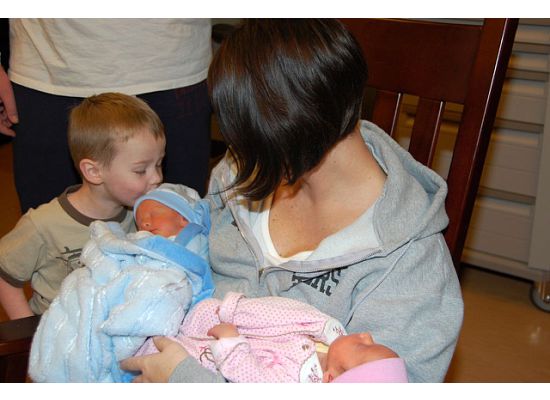
***I became a stay-at-home mother when my oldest son, Noah, was one year old. I love this role. After a difficult pregnancy and delivery, we had triplets in December 2008. Owen and Ella joined us at home a few weeks later. Owen has developmental delays, physical disabilities, and several issues with the function and formation of his brain. He received early intervention services (OT, PT, DT, and speech). He is the reason I plan to become a developmental therapist.

 • Exploring My Biases
***I am very blessed to have a very diverse family (varying sexes, races, sexual orientation, religions, cultures, ability). These differences are beautiful and I love my family!
(PHOTO: Hunting for pumpkins! So much love!)
• Exploring My Biases
***I am very blessed to have a very diverse family (varying sexes, races, sexual orientation, religions, cultures, ability). These differences are beautiful and I love my family!
(PHOTO: Hunting for pumpkins! So much love!)
 • Going Deeper…
***My son, Owen, recently had surgery on his brain at a local pediatric hospital. People travel long distances for the premium care that they receive at Riley Children’s Hospital. I had the opportunity to meet people from various cultures. In this experience, culture refers to many different aspects. Culture includes (but is not limited to) many factors such as heritage, race, sexual orientation, religion, financial status, and even medical history.
• Going Deeper…
***My son, Owen, recently had surgery on his brain at a local pediatric hospital. People travel long distances for the premium care that they receive at Riley Children’s Hospital. I had the opportunity to meet people from various cultures. In this experience, culture refers to many different aspects. Culture includes (but is not limited to) many factors such as heritage, race, sexual orientation, religion, financial status, and even medical history.

 ***While at the hospital, I met several wonderful families. One area that I noticed made me uncomfortable was communicating with children who are non-verbal. My son has limited vocabulary, so this realization was unsettling to me. However, I believe that my discomfort stems from lack of confidence in my skills to effectively communicate with them.

 Photos: Owen and his buddy, Jacob. Jacob and Owen are three years old. Owen has Traumatic Brain Injury, Diffuse White Matter Loss, and Erb’s palsy. Jacob has Cerebral Palsy. They love to play together!
***www.thejacksoncenter.org***
• MY PLAN…
***Last week, I had the wonderful opportunity to visit a school (The Jackson Center for Conductive Education). My friend’s son, Jacob, attends the school. Jacob is three and has cerebral palsy. Jacob has a very limited vocabulary. Several of Jacob’s classmates were non-verbal. I was so pleased to learn new skills, watch therapists/teachers show parents new strategies to use with their children, and gain some new strategies to more effectively communicate with children who are non-verbal. I watched my friend, Paula, learn how to utilize a “word button” to allow Jacob to communicate his needs. Jacob used a “yes” and “no” button when asked questions. I look forward to learning so much more through visiting this center and watching Jacob (and his older sister) overnight in September. I believe that by gaining confidence and learning new strategies, I will be a more skilled developmental therapist (my future profession)!
Photos: Owen and his buddy, Jacob. Jacob and Owen are three years old. Owen has Traumatic Brain Injury, Diffuse White Matter Loss, and Erb’s palsy. Jacob has Cerebral Palsy. They love to play together!
***www.thejacksoncenter.org***
• MY PLAN…
***Last week, I had the wonderful opportunity to visit a school (The Jackson Center for Conductive Education). My friend’s son, Jacob, attends the school. Jacob is three and has cerebral palsy. Jacob has a very limited vocabulary. Several of Jacob’s classmates were non-verbal. I was so pleased to learn new skills, watch therapists/teachers show parents new strategies to use with their children, and gain some new strategies to more effectively communicate with children who are non-verbal. I watched my friend, Paula, learn how to utilize a “word button” to allow Jacob to communicate his needs. Jacob used a “yes” and “no” button when asked questions. I look forward to learning so much more through visiting this center and watching Jacob (and his older sister) overnight in September. I believe that by gaining confidence and learning new strategies, I will be a more skilled developmental therapist (my future profession)!


Wednesday, August 1, 2012
Seeing Diversity Blog: Week 6
Seeing Diversity Blog: “We Don’t Say Those Words in Class!”
This is such an interesting blog! I could write volumes!!! I have had this happen so many times. However, I must say that the reaction of the adults in the situation set the tone for the child.
For example, while waiting in line at Wal-Mart one day my oldest son asked, “Why does the man behind us have on sunglasses in the store”. The man behind us was blind. I told Noah that God makes everyone special and that the man could not see. Noah just shook his head and said, “like how you don’t make sugar (his reference to my diabetes), his eyes don’t work”. I told him that his statement was true. The man smiled because he had heard our conversation. He asked Noah if he wanted to look at his dog (which was standing on the other side of the cart). Noah was thrilled. The man told Noah that since his eyes did not work, his hearing was extra special. Noah told him that he liked his “extra special power” and because it was snowing outside (and Noah is fixated on Christmas), Noah asked the man if he could hear snow falling. The man told Noah that he never tried, but would when he got outside. This was a very pleasant conversation.
However, the interaction could have happened very differently. I think that it is important for the adults to acknowledge the statement and not ignore it. While the adult may not have the exact answer, the adult speak to the child about what they saw. If I would have told Noah to be quiet, he may have thought that he did something wrong or that being blind is something to be ashamed of. The man’s response was also very important. He was very polite and informative. He was very matter-of-fact about being blind. He provided information that helped Noah process the information without bias and promoted acceptance. As an early childhood educator, it is important to acknowledge questions or statements. It is also important to ask questions about the topic (such as why do you think they are different). These questions can start conversations that promote acceptance. I understand that not everyone believes in God and in a public school setting, it is important to remember that. In these instances, one can refer to science as the reasoning for some differences. I think that the misconception about "only teaching white children about diversity" if they are in a group that is diverse is a very important statement (Derman-Sparks & Ramsey, n.d., p.43). What if a child is never in a class with a person who is blind? Should that class not learn about this form of diversity? The fact is diversity is everywhere and teaching children to see the beauty in differences is important.
Monday, July 23, 2012
Update on my family...
We are home from the hospital and Owen is doing "okay". He has chemical meningitis, which is a complicatin from surgery. He is taking massive steroids and they increased his pain medications. He is feeling pretty rotten, but did mention his catch phrase "this is the best day ever" today! That was wonderful to hear. We return to the hospital in the morning for more labs and a CT scan. Praying for normal test results for the genetic test for MLC-1 and all other labs. Love my kids so very much.


Subscribe to:
Posts (Atom)