Hello! I am excited to be starting another course and "chugging" through these courses. I must say, this educational experience is soooooo much different (with a husband, kids, bills, etc) than my experience at Purdue, but I am learning so much.
Part 1: Establishing Professional Contacts
I have emailed several people and have a response from one that is willing to discuss the information with me. I am excited to learn more about her and Hungary's early childhood system. Many of the people are concerned about the time constraint, so I am trying to contact more than one so I have a back up each week.
Part 2: Expanding Resources
I am excited about the www.zerotothree.org organization. I have looked at specific articles on the website before, but never took the time to really read it. It has a lot of information. One thing that caught my attention was the BRAIN MAP section this week. My son, Owen, has significant diffuse white matter loss throughout his brain, so I am always intrigued by articles concerning the brain. (Owen is still undergoing genetic testing and HOPEFULLY his condition is non-progressive. Feel free to visit his site at www.caringbridge.org/visit/owenred) I signed up for mail from them and registered. Excited to learn more.
My advice to you about establishing contacts is try a lot of people. I am always so nervous that I will not have the information that I need when I have to post, so hopefully with more than one person I will have at least one person respond in time.
Best wishes to you all!!!
Sarah
Friday, November 4, 2011

Friday, October 28, 2011
Request...
Thank you all for great posts during this course.
It has been a pleasure getting to know each of you.
 I have a favor to ask each of you. My son, Owen, is going through some major genetic testing. Would you mind saying a prayer to whom ever you pray to or ask for guidance for normal test results for him. We pray that the white matter loss in his brain shows no progression, he continues to gain skills, and NEVER shows signs of regression. Thank you all!
It has been a pleasure getting to know each of you.

Wednesday, October 12, 2011
My Supports!
I feel as though I have a wonderful support system. My family is my rock. They keep me going. My children help me to be patient. My husband helps me to find humor in things. My parents keep me grounded. I find comfort daily in my FAITH.
I am a list maker. Creating a list helps me stay organized and on-time. It also allows me to calm down and be less anxious. Without my list, I get distracted, spend more, and lose my train of thought.
I always make time to play with my kids each and every day. While I often find myself being busy (often with homework...), I take the time to play with them. I learn so much from their innocence, their attitude, and their patience with me. It helps me to be the mom that I want to be. I would be lost without my babies.
I pray a lot during the day. This helps me relax and comforted. There have been times in my life when I have not prayed as much and I often find myself to be more uptight. Prayer helps me find my inner peace.
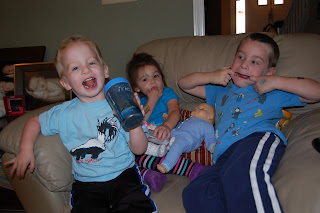
Photos: Noah, Owen, and Ella...my little playmates!
Brian and I...I fell in love with his humor!
The Holtz's going to church last Easter. We love to go to church together, play together, and PRAY together!


I am a list maker. Creating a list helps me stay organized and on-time. It also allows me to calm down and be less anxious. Without my list, I get distracted, spend more, and lose my train of thought.
I always make time to play with my kids each and every day. While I often find myself being busy (often with homework...), I take the time to play with them. I learn so much from their innocence, their attitude, and their patience with me. It helps me to be the mom that I want to be. I would be lost without my babies.
I pray a lot during the day. This helps me relax and comforted. There have been times in my life when I have not prayed as much and I often find myself to be more uptight. Prayer helps me find my inner peace.
Photos: Noah, Owen, and Ella...my little playmates!
Brian and I...I fell in love with his humor!
The Holtz's going to church last Easter. We love to go to church together, play together, and PRAY together!


Tuesday, September 27, 2011
My Connections to Play!
"Play energizes us and enlivens us. It eases our burdents. It renews our natural sense of optimism and opens us up to new possibilities." -Stuart Brown
"In play a child always behaves beyond his average age, above his daily behavior. In play it is as though he were a head taller than himself." -Lev Vygotsky
My parents both encouraged play in different ways. My dad encouraged me to build by making drawings and creating them. He is a very literal-type player. My mom encouraged play that involved nature. We lived in the country and I would map maps, go on hikes, build forts, and play adventurer. My sister is 3 years older than me and I idolized her. She did not particullary enjoy being outside. She liked dolls, playing house, and drawing. I loved interacting with others. Growing up, I particullarly enjoyed painting, building, and being outside. I was also a pretty literal player.
Times have changed a bit since I was little. Technology is everywhere. While I think that there can be some educational benefits to electronic games, it can allow the child to not use their entire creative ability or social skills. Families are very busy. Organized sports are starting at a very young age. In some cases, these organized sports have taken the place of playtime.
I hope that young children are encouraged to play and use their imagination. I hope that children are encouraged to play in various ways other then their preferred way. For example, my oldest son, Noah, is a very imaginative player. He loves to create new themes for play and use toys for various other ways other than their purpose. Our little neighbor boy, Ty, is a few months older than Noah. Ty is a very literal player. I think that it is great to watch them interact and push each other to play in various forms.
Photos: (These are examples of things that I enjoyed doing as a child!)
Noah, Owen, and Ella playing outside and enjoying each other!
Noah loves play-doh!
The boys playing with my old Legos.
Ella playing babies.
Owen playing with his blocks and trucks.


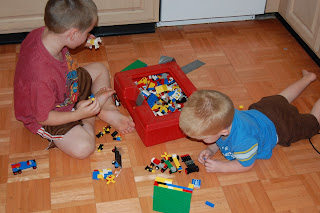

 Play has given me adventures that I may never actually experience in my lifetime. It allowed me to learn social skills, build friendships, create new ideas, and become comfortable being by myself. As an adult, I try to encourage my children to play in various ways. Noah is very imaginative. Ella loves to play babies and make-believe. Owen loves order in his play. He loves to line up trucks and stack blocks. All of my kids like to play outside and I enjoy watching them learn!
"Play energizes us and enlivens us. It eases our burdents. It renews our natural sense of optimism and opens us up to new possibilities." -Stuart Brown
"In play a child always behaves beyond his average age, above his daily behavior. In play it is as though he were a head taller than himself." -Lev Vygotsky
My parents both encouraged play in different ways. My dad encouraged me to build by making drawings and creating them. He is a very literal-type player. My mom encouraged play that involved nature. We lived in the country and I would map maps, go on hikes, build forts, and play adventurer. My sister is 3 years older than me and I idolized her. She did not particullary enjoy being outside. She liked dolls, playing house, and drawing. I loved interacting with others. Growing up, I particullarly enjoyed painting, building, and being outside. I was also a pretty literal player.
Times have changed a bit since I was little. Technology is everywhere. While I think that there can be some educational benefits to electronic games, it can allow the child to not use their entire creative ability or social skills. Families are very busy. Organized sports are starting at a very young age. In some cases, these organized sports have taken the place of playtime.
I hope that young children are encouraged to play and use their imagination. I hope that children are encouraged to play in various ways other then their preferred way. For example, my oldest son, Noah, is a very imaginative player. He loves to create new themes for play and use toys for various other ways other than their purpose. Our little neighbor boy, Ty, is a few months older than Noah. Ty is a very literal player. I think that it is great to watch them interact and push each other to play in various forms.
Photos: (These are examples of things that I enjoyed doing as a child!)
Noah, Owen, and Ella playing outside and enjoying each other!
Noah loves play-doh!
The boys playing with my old Legos.
Ella playing babies.
Owen playing with his blocks and trucks.


Friday, September 16, 2011
Relationship Reflection
*What do I look for in a friendship? -honesty, straightforward communication, mutual respect, nonjudgemental
*What special characteristics helps them stand out from other relationships? -I think that it is important to have a lot of mutual communication, to not feel that I am the only one trying in the relationship, honesty, not feeling judged, and feeling respected.
*What would my life be without the "influential" relationships? -I love being able to be open and honest. I like having a good time and helping others when needed. I would be lonely without these wonderful relationships.
*What helps maintain these relationships over time? -mutual respect, honesty, open communication
*How can the experiences learned from these relationships impact my work as an effective early childhood professional? -I learn a lot from my loved ones. I have learned to be open and honest. I trust my loved ones and love not being judged.
My parents have taught me a lot about relationships. I have a wonderful relationship with each of my parents. We speak daily. We are honest with each other. They do not judge me and help me in deciding important points in my life. They talk openly with me and are caring. This is type of relationship that I sought after in a mate. I formed a wonderful relationship with my husband, Brian. He is caring, honest, respectful, and nonjudgmental. I hope that this is the type of relationship that I am forming with my own children.
While writing down my "important" factors in a relationship, all of the points were things that this week's information encouraged in between parents and teachers.
Saturday, August 20, 2011
Saturday, August 6, 2011
Whole Child Approach
It is important for educators to align resources to students’ multiple needs and advocate
for a more balanced approach.
"What works best for children? What must we all—educators, families, policymakers, and
community members—do to ensure their success? Answering those questions pushes us to
redefine what a successful learner is and how we measure success. A child who enters school
healthy and feels safe is ready to learn. A student who feels connected to school is more likely
to stay in school. All students who have access to challenging and engaging academic programs
are better prepared for further education, work, and civic life. These components must work
together, not in isolation. That is the goal of whole child education." (Retrieved from: http://www.afterschoolnetwork.org/)United States and Poland
In both countries children are obligated to attend schools up to certain age. In the USA there are public primary schools and secondary schools. If someone wants to attend colleges or universities, he or she has to pay for it. In Poland the government pays for all schools- there are public primary, secondary and high schools, as well as colleges and universities. Of course there are private schools in Poland, but every citizen has an opportunity to educate for free from pre-kindergarten up to the university. This is a wonderful opportunity.
In America there exists an imperative to work harder and harder and to keep on looking for a better paid job. There are many people, who spend up to 18 hours a day at work. They have no time for social or private life. They have fewer friends and pay no attention to their neighbors. In Poland people usually know their neighbors, they also make friends and meet them regularly.
In America there are less unemployed and really poor people. Of course, there are some, but in reality, people, who want to work hard and are quite intelligent have a chance to achieve success. The living conditions in the USA are much better than in Poland. If you get a job in America and you work hard, you can afford a car, nice holidays and you do not have to worry about your future. In Poland the salaries hardly ever let you live on such level and you can never be sure, what your future will be like. Polish people are paid less money for a job, for which the Americans are paid much more. At the same time, the costs of living in Poland and in America are not much different.
http://www.afterschoolnetwork.org/
www.wiki.com/poland
Subscribe to:
Posts (Atom)